The Legal Case for War
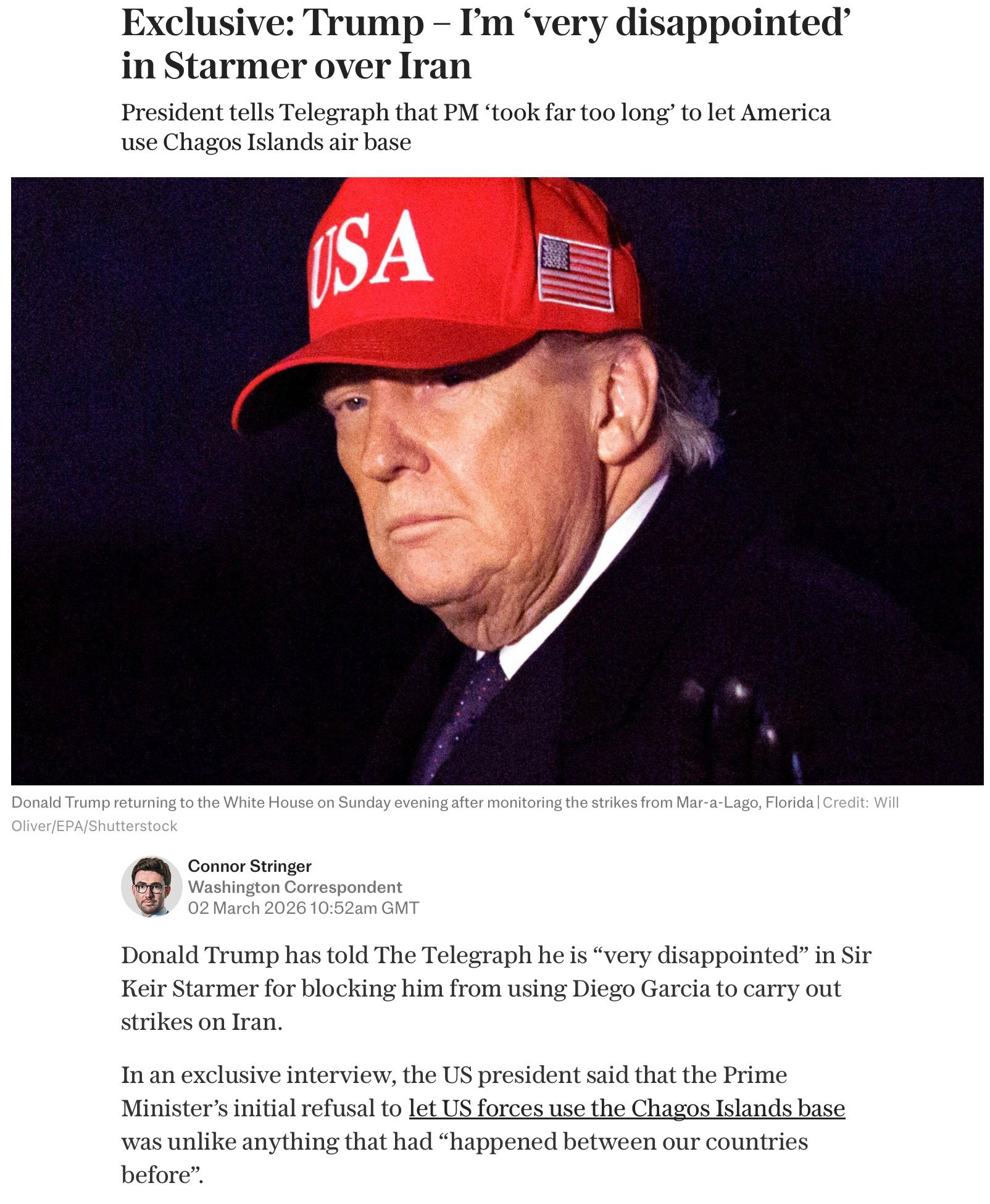
Sir Keir Starmer did not initially allow the United States to use British bases in the UK, Cyprus, and the Indian Ocean (the Chagos Islands) to launch the joint US-Israeli assault on Iran. While Starmer cited legal reasons, I suspect it had more to do with concerns over another backbench rebellion – and the Muslim vote. Either way, it has damaged US-UK relations.
David Wolfson KC (the Shadow Attorney General) has set out why he believes there was NO legal impediment to Starmer allowing the US to use British bases and Starmer is just plain WRONG.
This is David Wolfson’s analysis:
The Prime Minister has refused publicly to support the US and Israel strikes, and also refuses to allow the US to use UK bases, because of international law advice he has reportedly received from Lord Hermer.
International law ought to provide a mechanism to restrain and, if necessary, end despotic and tyrannical regimes such as that in Iran. If the doctrines of international law prove unable to restrain Iranian terrorism and mass murder, and tie the hands of democracies while forcing them to stand and watch Iranian atrocities, international law will have failed. It will have become a fundamentally immoral system of law, and one which is worse than worthless in the modern world. To be clear: I don’t believe that it is. I think international law is important, and both can and should provide a just legal order. I do, however, have serious questions as to the moral attitudes of some of its expositors; too many international lawyers serenely promote an analysis which ultimately protects tyrants. Seven points, and some questions:
1 The inherent right to use force in the face of an imminent attack from a hostile nation which is responsible for a pattern of hostile actions exists for good reason: a country cannot be expected to remain idle and just wait for the next attack.
2 Iran has repeatedly threatened to attack the UK’s bases and personnel. Those threats come in the context of persistent Iranian attempts to launch attacks on UK soil, too; the Director General of MI5 has stated, and the PM confirmed last night, that the UK has responded to tens of Iranian-backed plots, presenting potentially lethal threats to British citizens and UK residents. There is also a constant barrage of cyberattacks; while not all cyberattacks are armed attacks in sense of Article 51 of the UN Charter, some may be, and all confirm not just hostile intent but action pursuant to such intent.
3 The UK’s long-standing allies, the US and Israel, were right to consider that they faced further attacks prior to their recent military action, given that (i) Iran has previously attacked both states directly and also through its many proxies; (ii) Iran has repeatedly stated its intent to destroy Israel; (iii) Iran was assessed to be on the brink of acquiring a nuclear capability with uranium enrichment at 60% (which can only be for military use); and (iv) Iran already possessed – as demonstrated by its recent attacks – a sophisticated and effective long-range delivery capability which Israel cannot fully neutralise with defensive weapons.
4 The acquisition of a nuclear capability by Iran represents a genocidal risk for Israel and its people. Iran’s repeatedly stated aim is to wipe the State of Israel, and its inhabitants, off the face of the earth. The slogan of the proxies through which Iran has often attacked Israel is: “God is greater, death to America, death to Israel, curse to the Jews, victory to Islam”. In these circumstances, whether they are characterised as part of an ongoing armed conflict with Iran or as a new use of force based on self-defence, Israel’s actions are justifiable.
5 The UK (and also the US) is permitted under international law to use force to aid another state which is acting in self-defence. Moreover, the UK is under an obligation in international law is to prevent genocide, not just to stop it: stopping an on-going genocide is required, but it necessarily means that action was taken too late.
6 Against that background, the UK has three distinct legal bases to assist, militarily if necessary, its long-standing allies the US and Israel (and now other states in the region, too):
(1) to defend another member state pursuant to collective self-defence;
(2) to take proportionate action to avert continued Iranian attacks on the UK’s own bases and personnel; and/or
(3) to prevent Iran from implementing its clearly stated genocidal intentions against the people of Israel.
7 The US and the UK are in the same legal position; accordingly, if the UK Government’s position (as reported) is that the UK cannot itself take offensive military action to support the US and Israel, the UK Government must also consider that the US strikes were unlawful.
8 Some questions for the UK Government:
(a) Does the UK Government consider that the US and Israeli strikes were unlawful?
(b) Why could we not join the leaders of Canada (Liberal) and Australia (Labor) and offer unequivocal support?
(c) Why are we not actively assisting our several other allies in the region, throughout the Gulf and beyond, who have now also been attacked?
(d) Specifically, is it the UK’s position that we can help those states defend themselves against missiles once launched, but we can’t actively assist them in taking out the missile launchers?
The legal debate about these matters is important. And any government should be cautious before using or endorsing lethal force. But when your first point in responding to targeted strikes on a tyrannical regime which has sought to attack, and which still plans attacks against, your own citizens both at home and abroad, is “We did not participate”, you need to rethink your analysis.
Last night’s speech delivered by the Prime Minister was, frankly, embarrassing. He laid out all the threats to the UK – including clear physical threats to my own community – but then failed even to say that he supported military action to remove those threats. His overriding concern was simply to make it clear that the UK did not participate in the US and Israeli strikes. In that context, lack of participation is not a badge of honour; it is a mark of shame. It is amoral evasion dressed up as legal principle.